|
Many metals are structurally weakened by the oxidation process, but not aluminum. Aluminum can actually be made stronger anㅁd more durable through a process called 'Anodizing'. Anodizing involves placing a sheet of aluminum into a chemical acid bath, quite often acetone in laboratory experiments. The sheet of aluminum becomes the positive anode of a chemical battery and the acid bath becomes the negative. An electric current passes through the acid, causing the surface of the aluminum to oxidize (essentially rust). The oxidized aluminum forms a strong coating as it replaces the original aluminum on the surface. The result is an extremely hard substance called anodized aluminum.
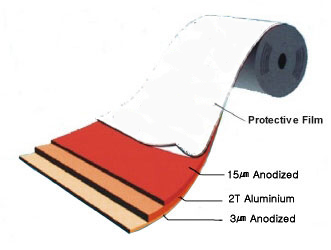 Anodized aluminum can be nearly as hard as diamond under the right anodizing process. Many modern buildings use anodized aluminum in places where the metal framework is exposed to the elements. Anodized aluminum is also a popular material for making high-end cookware such as frying pans and pots. Heat is distributed evenly across anodized aluminum, and the process of anodizing provides a naturally protective finish. It is possible to use another electroplating process to make anodized aluminum look like copper or brass or other metals. Special dyes can also be used to color the anodized aluminum for decorative uses. Anodized aluminum can be nearly as hard as diamond under the right anodizing process. Many modern buildings use anodized aluminum in places where the metal framework is exposed to the elements. Anodized aluminum is also a popular material for making high-end cookware such as frying pans and pots. Heat is distributed evenly across anodized aluminum, and the process of anodizing provides a naturally protective finish. It is possible to use another electroplating process to make anodized aluminum look like copper or brass or other metals. Special dyes can also be used to color the anodized aluminum for decorative uses.
Because of its strength and durability, anodized aluminum is also used in a number of other applications. Many of the satellites circling the Earth are protected from space debris by layers of anodized aluminum. The automobile industry relies heavily on anodized aluminum for trims and protective housings for exposed parts. Furniture designers often use anodized aluminum as the framework for outdoor pieces as well as the base metal for lamps and other decorative items. Modern home appliances and computer systems may utilize anodized aluminum as protective housing.
Anodized aluminum may not be appropriate for all applications because of its non-conductive nature. Unlike other metals such as iron, the oxidation process doesn't seem to weaken aluminum. The layer of 'aluminum rust' is still part of the original aluminum and will not transfer to food or easily flake off under stress. This makes it especially popular for food-service applications and industrial applications where durability is crucial.
Process
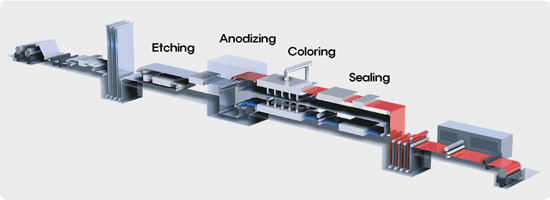
Etching (Chemical Milling): Etching in caustic soda (sodium hydroxide) prepares the aluminum for anodizing by chemically removing a thin layer of aluminum. This alkaline bath gives the aluminum surface a matte appearance.
Anodizing: Aluminum is immersed in a tank containing an electrolyte having a 15% sulfuric acid concentration. Electric current is passed through the electrolyte and the aluminum is made the anode in this electrolytic cell; the tank is the cathode. Voltage applied across the anode and cathode causes negatively charged anions to migrate to the anode where the oxygen in the anions combines with the aluminum to form aluminum oxide (Al2O3).
Sealing: In all the anodizing process, the proper sealing of the porous oxide coating is absolutely essential to the satisfactory performance of the coating. The pores must be rendered nonabsorbent to provide maximum resistance to corrosion and stains. This is accomplished through a hydrothermal treatment in proprietary chemical baths or by capping the pores via the precipitation of metal salts in the pore openings.
Technical Data
The physical properties listed below are based on testing coil anodized aluminum with a 0.01 "EPC coating film thickness Salt Spray (ASTM B-287-74) : No change after 300 hours in acidified salt spray cabinet.
Uviarc : No change after 96 hours (specimen located 12" from mercury vapour arc lamp.)
Weather-Ometer : No change after 1000 hours. Testing using Atlas Model XWR Dew Point Cycle Weather Ometer.
Resistance to Bleaching : No change when treated with 30% hydrogen peroxide for a period of 24 hours.
Specification & Finishes
ALUMATE offers a wide variety of thicknesses from .20mm (.008") up to 1.6mm (.063") in coil form 1320mm (52") wide. The maximum coil weight is 6000 lbs.
Anodized coating thickness in coil form can be supplied in clear ranging from flash up to 17 microns (.0007") and colours up to 10 microns (.0004).
In heavier sheet form from 2 mm (.080) to 3.2 mm (.125") clear bronzes and black anodic coatings of 17 microns (.0007") are available. Clear anodized and standard bronze in lighter gauges are kept in stock. 3.2 mm (.125") sheets can also be supplied to a maximum
width of 1524 mm (60").
ALUMATE offers sheet lengths to the customers' desired measurements which results in substantial cost savings.
Only high quality aluminum alloy 5005H14 is used from specific mills.
This ensures the products supplied meet stringent architectural demands. |